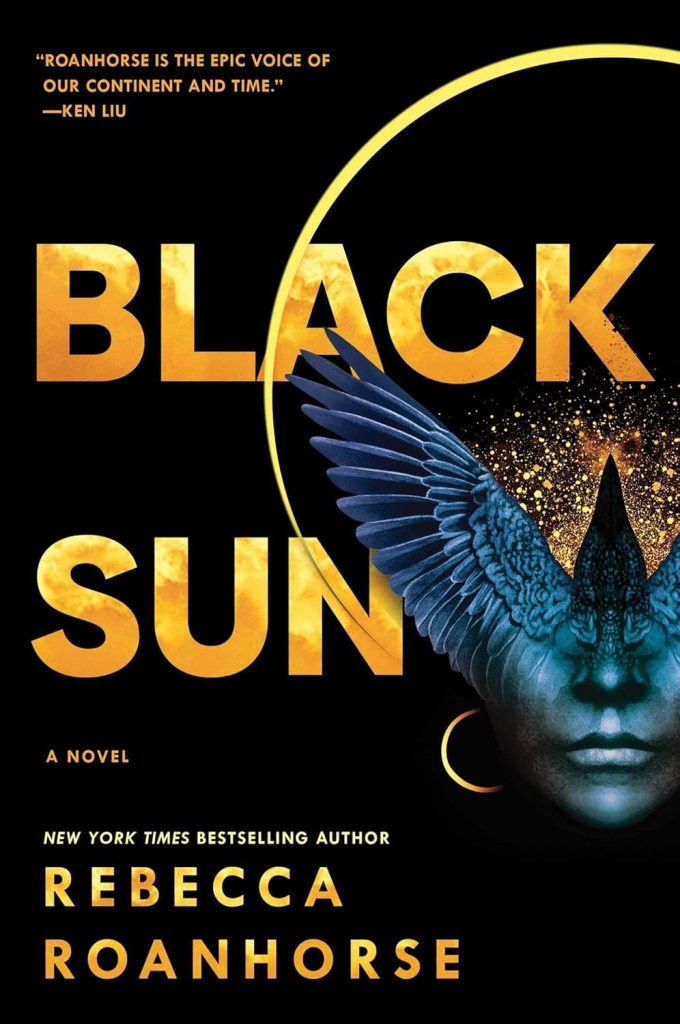
First of all, if Rebecca Roanhorse is not already an author you are watching, you’re making a mistake. I teach her “Welcome to Your Authentic Indian Experience” story in my literature course every year; it won the Hugo and the Nebula award. You absolutely need to read Black Sun, and the other books in the Between Earth and Sky trilogy. And basically anything you see by Roanhorse. She’s incredible.
When Black Sun came out in 2020, I was SO on board (we don’t need to talk about how long it took me to read it–that wasn’t the book’s fault). Around the same time, an unrelated RPG called Coyote and Crow hit Kickstarter. Indigenous American visions of a fantasy world–or even an alternate history of our world–in which their stories get to blossom without the oppression of colonialism hit the literary world like a TRUCK. The literary world is famously slow moving . . . and famously stubborn about new things. The presence of Indigenous American cultural influence in fiction was not new in the 2020s, to be clear. But Indigenous voices, as with Black voices and LGBTQ voices and female voices and all manner of marginalized voices, were finally being published in accessible spaces. And my imagination will never be the same.
Black Sun offers a truly unique experience. There are familiar fantasy elements with Indigenous flavor–the celestial tower is a reskin of any wizardly tower in any magocracy, there’s a reluctant hero Chosen One narrative, and so forth–but those familiar elements amplify how delectably new everything else is.
Roanhorse’s writing is attentive and perceptive. Her characters are not oblivious NPCs along for a ride. They’re observant and clever, aware of their own shortcomings, aware of what makes them who they are, aware of machinations working against them. They have human desires, and realistically complex interpersonal relationships. I quickly became attached to and invested in every perspective character. If I had any complaint, it’s that switching to another perspective when the perspective I had been in ends with a cliffhanger sometimes was not welcome. Once I specifically skipped ahead like four chapters to the next chapter from the same perspective because I desperately needed to know what was next for that character. That’s more of a me problem than a Roanhorse problem, though. I was just really into it and not ready to move on.
The worldbuilding in this book is also a genuine delight, especially for fans of dark fantasy (I very much am). I immediately understood the politicking and general structure of society in Tova, at least in broad strokes, and it easily became more complex as the events of the narrative unfolded. It also helps that the writing is so vivid. I can picture the red-stained teeth of the Odo, the shimmering multicolored eyes of the Teek, the swaying rope bridges that bind Tova’s clans together like so much duct tape. And, critically, Roanhorse is not a merely visual writer; this book is heavy with scents and tastes and textures that bring the world to life.
I will not discuss the plot in depth, to avoid spoilers, but I do want to say a few things related to plot that may impact a decision to buy/read the book. First, this is book one in a series. For some series, the first book is a stand alone; this is not. It absolutely ends on a cliffhanger–somewhat literally, even. There is no clear protagonist/antagonist, in that you will probably find yourself rooting for both Serapio and Naranpa, who are ostensibly on opposing sides of the central conflict. I would describe Xiala and Okoa as important supporting cast, rather than as main characters, even though they do get their own chapters (it was Xiala that I skipped ahead for). I imagine these dynamics do shift in the sequels. Currently, there are three books set in this world. Roanhorse has declared the Mirrored Heavens the final book, although it is not uncommon for authors to return to a world with new material in the same setting. I would welcome more stories in this world, of course.
Black Sun has been optioned by AMC for development into a series and seems to be moving forward, although there has been no significant updates or announcements about the adaptation in the past year. That said, novel to television productions seem to take far longer than one might expect–I’m still waiting for Nnedi Okorafor’s Who Fears Death to have any substantive update, and that was optioned in 2017 and was radio silent until a brief update in 2021 before going radio silent again. Don’t expect a show soon, but know it’s a genuine possibility . . . maybe in the 2030s.
Author’s Note: I am fully aware that there is not a single “Indigenous culture.” It’s very difficult to talk about the importance of marginalized groups by breaking them into smaller and more specific groups when the reality is that all of those smaller, more specific groups have been muted for about the same amount of time and for the same broad reasons. Black Sun draws from many sources of inspiration within various specific Indigenous cultures (see Roanhorse’s article in Reactor: https://reactormag.com/take-a-sneak-peek-at-the-world-maps-for-rebecca-roanhorses-black-sun/)–much like the familiar high fantasy of white folks is a mash-up of British, Irish, Scottish, French, German, Greek, Roman, and other distinct cultures. Remember than fantasy is not history, even if it has a real world point of origin.
 Cthulhuville
One response to “Black Sun”
[…] right now? I’ve currently about 10% of the way through Fevered Star, the sequel to Black Sun. I’m between shows right now and my entire watch list is foreign language stuff (for better […]
LikeLike