
Skip the first paragraph. It isn’t about the game really. I mean, don’t actually skip it. I wrote it so you would read it. But if you are purely looking for a concise review of the game, then you may want to skip it. But if you want that I’m shocked you are reading my post as I have a tendency to meander a bit now and then. It is a testament to you that you are here reading this today! Go you!
First off, we have to murder the elephant in the room. This game is based on the comic book Manifest Destiny. A comic about Lewis and Clark exploring the country, but focusing on the untold story that their trek was fraught with monstruous flora and monstruous monsters as well the dangers we all know of. The game was rebranded because the term Manifest Destiny is taboo. And I get it. Early Americans were assholes. Manifest Destiny is associated with the injustices committed against Native Americans. Early settlers were the problem. Not a comic book or a board game.
Back to the game, or rather starting the game discussion. I was excited for this game as I had read the comic. And I’m partial to board games. This game also comes with a solo mode. It comes with a ton of gameplay potential. Six different game modes with multiple maps and I got it via the Kickstarter campaign, so I got a bunch of extra maps and goodies (22 came with the game, but there’s like another 20 thanks to Kickstarter.) And the publisher has stated that they plan to release maps which could be printed.

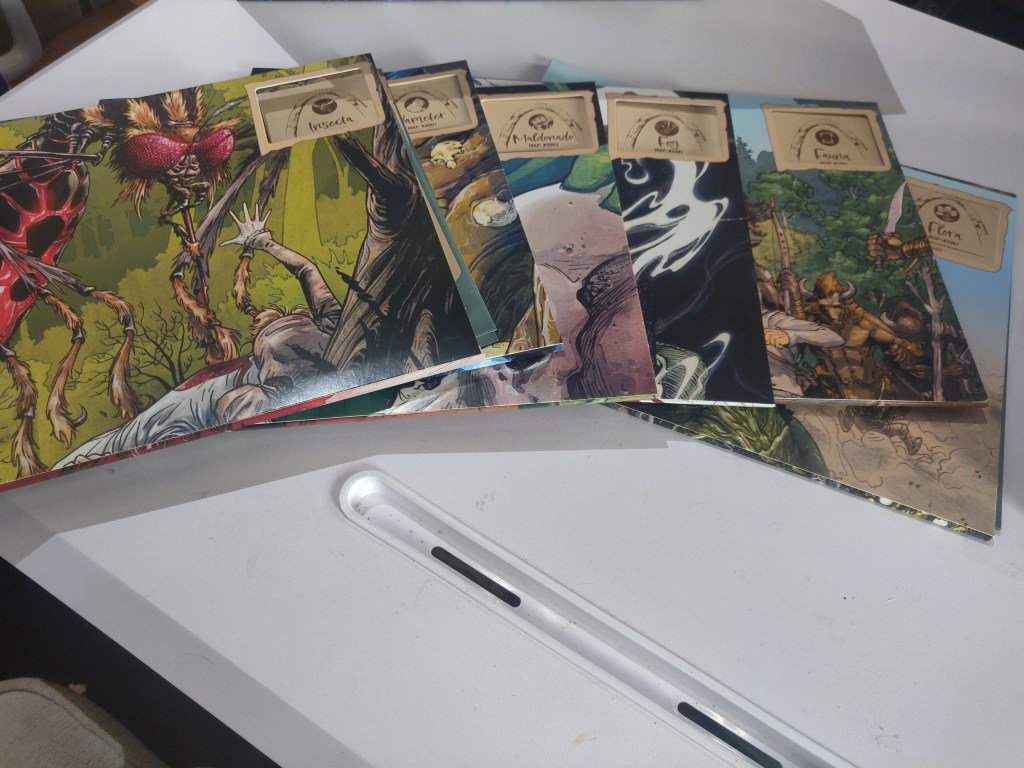
You can see the board here and it is covered with circles. The game plays out by lifting those circles off and revealing the map. Very puzzley. But there are cards that make maps and gameplay variable.
There are challenge cards that you need to complete to make progress towards winning. And each different game type has its own set of challenge cards. Which actually brings me to a complaint I have. And it astounds me that I am going to say this. The game has an amazing insert (sorry Mike) that keeps everything separated. Which I love. And the cards and bits were all separated for each of those sections. But the game got jumbled in transit. So the cards weren’t in the right section, but I didn’t realize that. I honestly think I would have preferred all the cards together in one deck and I had to open and sort them. Because then I would have known which cards were in which section. Instead I was trying to play not realizing I had cards from the wrong section.
Which leads me to another complaint I had. The training mission was not fun to figure out. There should have been a quick start sort of pamphlet for it. But there isn’t. You have to learn the rules for the game and then there is a page about the Training Mission and how it deviates from the game. It wasn’t super clear though how to set it up and play.
My suggestion is actually ignore the Training Mission and just play the game. The book clearly explains how to set up for the game.
But the game itself I like a lot. Although I imagine I will play through most of it as a solo campaign. My shelves are brimming with games I want to play, and most of them are not designed for solo play. I do recall reading that this game was designed for solo play and then adjusted to make it multi player. I do wonder how that impacts the flow of it. As I ponder upon this train of thought, I realize that I may never play it multi-player. I don’t readily see a benefit to other people. (Specifically sitting around the table playing this game, not in the world in general. That is a whole different discussion. And while I may at times derail myself, I shall not on this particular topic.)
My initial thought is that I am giving this game a 9 Star rating. I know it will get more time on the table because it is a good solo game. So much variability that I can imagine even leaving the bits out on my table for days at a time.
 Cthulhuville