
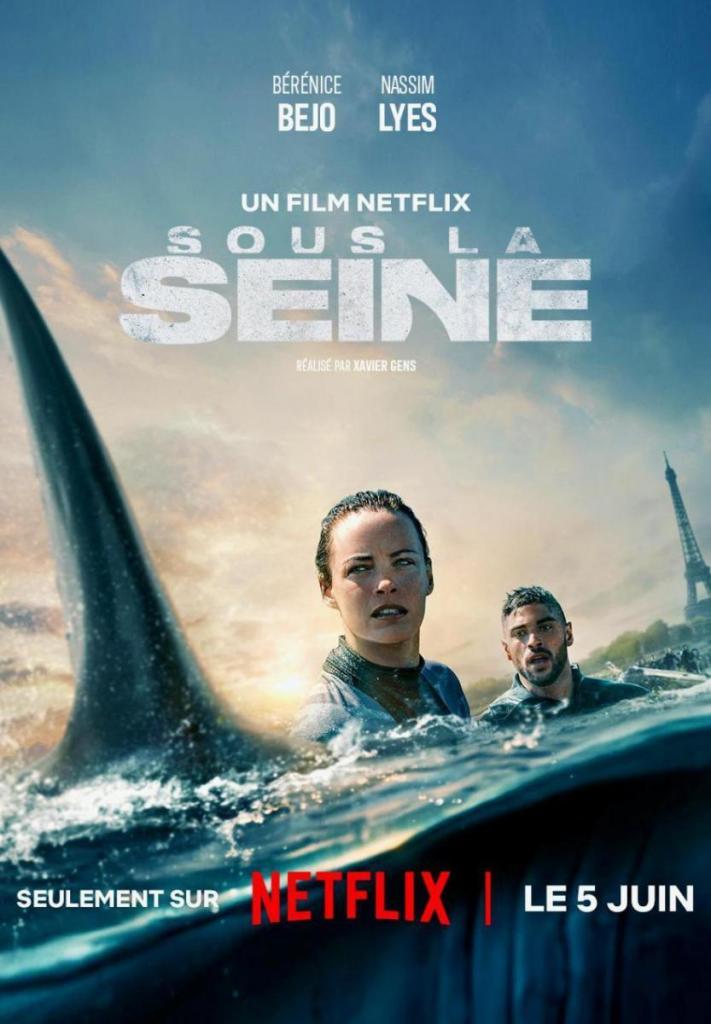
If you’re looking at my star rating and that of the rest of the critical world, let me start with “I know.” You’re welcome to disagree with my rating, but in order to explain my perspective, you’re going to have to stay with me for a minute. This is not just a movie review; this is also an editorial commentary, because I have some things to get off my chest.
Under Paris is being touted as a modern Jaws, and that perspective is not misplaced. The general concept lines right up: a shark of unusual size and with an aggression that suggests intelligence beyond the standard shark is locked in deadly conflict with the protagonist. If anything holds it down from taking the world by storm like Jaws did, it’s the lack of a memorable musical score.
I think some viewers (lots, based on public reviews) are getting hung up on the social commentary, which is admittedly being pushed pretty hard. They’re missing the trees for the forest, to bastardize the saying. Under Paris is absolutely eco-critical, and falls indisputably into the realm of eco-horror. However, the way it navigates its cautionary tale is multi-layered and nuanced. Spoilers ahead.
The movie’s opening scene introduces the eco-criticism with a short content creation moment: a man records his wife remarking on the volume of plastic waste in the ocean. They and their team uncover a juvenile sperm whale–dead of its consumption of plastic waste–being consumed by mako sharks (See the NOAA page for more information). They have been tracking a specific, tagged mako. Things go sideways, and the previously mentioned wife jumps into the water to help. She wounds the shark, but both the shark and the woman become partially entangled in a net. She is dragged away, too far down. The pressure damages he ears, her lungs, her nose, but she manages to make it back to the surface alive. Other than a woman who never left the boat and our wounded protagonist, the whole team has been killed.
Years later, the widow is approached by an environmental activist who has located the same shark. The problem? All of the data indicates that it has made its way into the Seine. This is where my understanding of the film seems to diverge from others. The filmmakers make a very explicit antagonist of the activists. They are desperate to return this shark to this ocean, and they sabotage the efforts of the local police (who the widow is working with to try to return the shark to the ocean). This is where I become a big fan of the nuanced approach to the subject.
At its core, the film is not some declaration that we must save our planet at all costs, or else the planet will save itself. Instead, the movie condemns both the disrespect of the masses (who generated the trash to begin with and are not working collectively to undo it) and the elites (the other antagonist is the mayor, of course) and the desperation of the few who are scrambling to reverse it. The shark-antagonist, representing nature herself, is adapting to the new world just fine.
In an attempt to save the people immediately surrounding her–that is, the people on and in the Seine–the protagonist and her allies ultimately destroy the protections in place in the Seine and flood the city of Paris. That which was once controlled is unleashed, both literally and figuratively. The waters of the Seine, no longer held back by human engineering, bring the surviving sharks–plural, making clear how intensely the protagonist’s efforts failed–up, the shark-infested waters climbing over cars, up tree trunks, and into second-story windows. So too, the film quietly suggests, will our best efforts fail. The planet is already adapting to our mistakes, and the tensions between self-interest, ignorance, and heroism will undercut any good intentions any individual one of us might have.
There is a concerning trend in the reading and viewing world: people have decided it is offensive to be presented with stories, books, films, and every other kind of art if it dares to remark on the world. The arts have always been a space for critical commentary. To condemn what is a genuinely good update to this sub-genre (I mean, shark horror is kind of its own sub-genre now, isn’t it?) because it dares to make a claim is to reverse the whole history of the arts, to elevate the Sharknados of the world (which has a 77% on Rotten Tomatoes) and bury the Under Parises is to abandon all hope of a better world. I know that sounds extreme, but improvement does not happen without imagination and critical thought; you must have both.
Under Paris is an excellent movie. It’s fun, it’s critical, it’s topical, it’s well-acted and cinematographically beautiful. The characters are realistically enmeshed through trauma bonding and societal conventions. The somewhat farfetched explosions are the only struggle I had, but even those were tame for what is being billed as a thriller. It’s a solid movie. Go watch it and reflect on the certain doom of mankind.
 Cthulhuville