
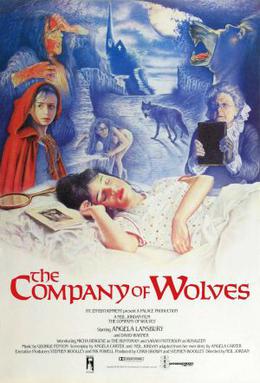
To start this review, I actually need to give some context for the film. The average horror or fairy tale fan is probably not going to enjoy this movie. It’s based on a short story of the same name, written by Angela Carter and appearing in her 1979 collection The Bloody Chamber. Carter’s work is deeply feminist. The short story is taught in college literature courses; I first encountered it in my “Human-Animal Transformations” class in undergraduate.

The story is a retelling of “Little Red Riding Hood.” One in which men (and in the film, some women) are predators who become wolves. Their becoming wolves is symbolic. The inside becomes reflected on the outside. Little Red Riding Hood is a girl on the cusp of womanhood, which means predatory men are all around her. The Wolf is the man who happens to encounter her in the woods. But unlike the Perrault story, there is no huntsman to save her. She saves herself by taking command of her sexuality, thus taming the wolf.
I imagine you spotted the problematic nature of this story. We have to remember that it was born out of an older feminism. It is not the feminism of the 21st century.
But what about the movie, McKenzie? Well, the movie is a fascinating adaptation of the story. It expands massively on the backstory of the original, including a more personal experience of Grandmother’s own history with wolves. The movie’s greatest failure is that it is ultimately mediocre as a werewolf movie. It’s an excellent adaptation but it does not really stand alone.
It is intensely symbolic, sometimes investing a whole scene in jump-cuts highlighting objects or animals that do not advance the plot but do deepen the film. If–and this is a big if–you’re already on the same page.
If you’re a fan of Carter, it’s a must-see. If you’re interested in feminist theory, it’s a must-see. But if you’re looking for a good werewolf movie, you can absolutely skip this one.
 Cthulhuville